
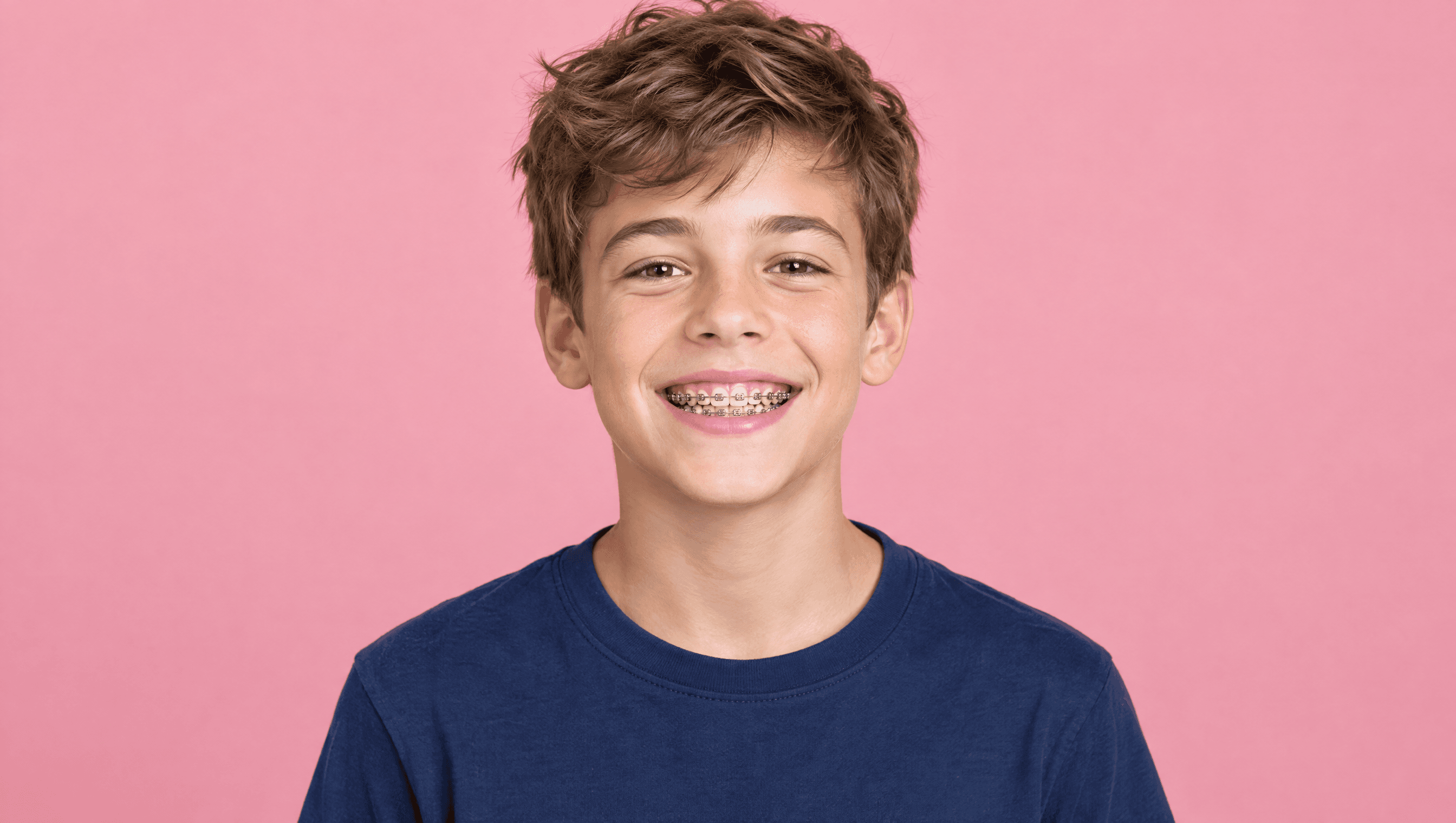
Orthodontics for Kids in Brisbane: When to Start and What to Expect
Most parents start looking into this after noticing something. An adult tooth is coming in behind a baby tooth, a gap has closed up, or a teacher, a grandparent or your child has pointed something out. Two questions usually follow: does this need fixing, and are we too early?
This guide covers how we work through those questions with Brisbane families, what the options look like at different ages, and roughly what treatment costs.
When should your child first be assessed?
The Australian Society of Orthodontists recommends a first orthodontic check between about 7 and 10. Seven surprises most parents, because at that age a child still has a mouth full of baby teeth.
By 7, though, the first adult molars and front teeth are usually through. That's enough to see how the jaw is developing and whether the adult teeth will have room. Roughly half of the children we see at 7 need some kind of early intervention. That might be changing a habit, addressing an airway issue or making room with an expander. For the rest, the answer is to keep an eye on things and check again at the right time.
If your child is 10, 12 or 14 and hasn't been assessed, you haven't missed the boat. A lot of treatment starts in the early teens once the adult teeth are through, and for many bites that's the right time anyway.
Signs it might be worth getting your child checked
You don't need to diagnose anything or spot these yourself. We check for them at every visit, but these are the things worth looking at:
- Adult teeth coming through crooked, rotated or behind the baby teeth
- Crowded teeth, or baby teeth falling out much earlier or later than their siblings' did
- Top teeth sitting well in front of the bottom teeth, or bottom teeth sitting in front of the top
- Front teeth that don't meet when the back teeth are together
- The jaw shifting to one side when they bite down
- Clicking, jaw discomfort or trouble chewing
- Thumb sucking past about age 5, or mouth breathing and regular snoring
- Covering their mouth when they smile, or being self-conscious in photos
Not all of these need treatment straight away, but they're all worth talking about. We'll look at them during a routine check-up and clean, so there's no need to book a separate appointment.
Early treatment or wait until the adult teeth are through?
This is the real decision, and it's where many parents feel pushed one way or the other.
What early treatment involves
Early treatment (also called interceptive or phase one treatment) happens while a child has a mix of baby and adult teeth, usually between 7 and 10. It's typically a shorter course with a specific job, such as making room for adult teeth, guiding the jaw as it grows, correcting a crossbite, or stopping a habit like thumb sucking from shaping the bite.
It can often involve a plate or an expander rather than full braces. The aim is to make a later stage of treatment simpler, and occasionally to avoid it. It isn't a guarantee that braces won't be needed later.
Why timing matters more than age
Bite and jaw problems don't correct themselves. Jaw issues in particular need to be treated at the right stage of development, and that stage doesn't always line up with a birthday. Two eight-year-olds can be at very different points.
That's why some children start early treatment at 7 and others are better monitored until the timing is right. If we recommend waiting, it's because it's not the right stage yet, not because we expect the problem to go away. We'll give you the reason and a date to review, not a vague "come back sometime".
Treatment options for kids and teens
Traditional braces
Fixed metal brackets and wires are still the most versatile option, and for complex crowding or bite problems they're often the most practical one. They work whether or not your child remembers to do anything, which for a 12-year-old is a real advantage. Adjustments are usually every six to eight weeks.
Clear aligners for teens
Clear aligners such as Invisalign Teen are removable, much less noticeable, and come out for eating, sport and cleaning. They suit teenagers who are self-conscious about braces and organised enough to wear them 20 to 22 hours a day. If your teen loses a water bottle every week, think carefully about this one. There's more on our Invisalign page.
In more complex cases, aligners may not achieve as good a result as braces. A lot depends on what we're correcting. If the goal is mainly a straighter smile, there's more flexibility. If it's a health concern, such as crowding that makes teeth harder to clean and more prone to decay, or a narrow jaw linked to airway problems, the appliance that does the job best matters more. We talk this through with your teen as well as you, because what matters to them shapes the plan.
Plates and expanders
Plates and palatal expanders are mostly used in younger children to widen a narrow upper jaw or create space for adult teeth. They're worn for a set period with regular check-ins. They can feel strange for the first week or two, and speech may be a little affected while your child gets used to them.
The right option depends on your child's bite, their age and how much jaw growth is still ahead. Our orthodontics and braces page covers each one in more detail.
What kids orthodontics costs in Brisbane
The cost depends on what's being corrected and how long it takes, so a single number isn't much use. As a guide, indicative ranges at our practice are:
- Early treatment (phase one), such as an expander, usually between ages 7 and 10: up to $5,000
- Follow-up braces or aligners after early treatment (phase two): $5,000 to $8,000
- Full fixed braces: $8,000 to $10,000
- Clear aligners for teens: $8,000 to $10,000
Retainers after treatment are included in the cost of braces.
What affects the price
How complex the bite is, how long treatment runs, whether one stage or two is needed, the type of appliance, and whether extractions are involved.
Health fund rebates, CDBS and payment plans
Most private health extras cover part of orthodontic treatment, but there's usually an annual limit, a separate lifetime orthodontic limit, and a waiting period that can be 12 months or more. If treatment is likely in the next couple of years, check your policy now rather than the week before you start.
The Child Dental Benefits Schedule (CDBS) covers basic dental care for eligible children, but it doesn't cover orthodontic treatment.
We offer payment plans to help families spread the cost. We'll go through the options with you in clinic.
How long treatment takes
Early treatment with a plate or expander often takes a matter of months. Full braces or aligners commonly run 12 to 24 months, depending on what's being moved and how consistently the appliance is worn.
After that comes a retainer, which isn't optional. Teeth tend to drift back toward where they started, and wearing a retainer as directed is what holds the result. Expect it to be part of life for a long time after the braces come off.
Life with braces: what changes day to day
Teeth usually feel tender for a few days after fitting and after each adjustment, so soft food helps. Hard and sticky food is off the menu for the duration: no biting into whole apples, no chewy lollies, and go easy on crusty bread. Brushing takes longer, and flossing needs a floss threader or an interdental brush.
Sport carries on as normal, but your child will need a custom mouthguard made to fit over braces. A boil-and-bite guard from the chemist may not fit properly over brackets and won't protect as well.
What happens at your child's first assessment
We look at how the teeth are coming through, how the jaws meet and how much growth is still to come, and take x-rays if we need to see teeth that haven't come through yet. Then we talk it through with you and your child, including the option of doing nothing yet.
If your child's case would be better managed by a registered specialist orthodontist, we'll tell you and refer you. And if your child is nervous about the dentist, let us know when you book. There's more about how we look after nervous patients on our anxious patients page.
Book your child's check-up and we'll take a look and tell you honestly whether anything needs doing yet. You'll find us at 29 Doggett St, Teneriffe.
Any dental treatment carries risks and outcomes vary between individuals. The information on this page is general in nature and is not a substitute for an assessment by a dental practitioner.
Frequently asked questions
Is 7 too early for an assessment?
No. An assessment at 7 can often lead to monitoring rather than treatment, and it gives you time to plan.
Can my child have braces while they still have baby teeth?
Sometimes, as part of early treatment. Full braces generally wait until most of the adult teeth are through.
Will braces hurt?
Having braces fitted usually isn't painful. Teeth tend to ache for a few days afterwards and after each adjustment, and over-the-counter pain relief is usually enough.
Will my child need a retainer forever?
For a long time, at a reducing frequency. Teeth move throughout life, and a retainer is what holds them in place.
What if my child won't cooperate with treatment?
Talk to us before you commit. We can match the appliance to your child, and fixed braces take most of the day-to-day effort out of their hands.

Dr. Hayden Stewart
Dr Hayden Stewart (DEN0001402662) is a Queensland-trained dental professional with over twenty-five years of experience.
Table of contents
Related Posts
Read more insights and advice on all things dental health, treatments and preventative care.
 Childrens Dental3 min read
The Long-Term ROI of Dental Care You’ve Never Heard
Unlock the true value of your smile with Teneriffe Dental’s guide to the long-term ROI of dental care. Discover simple ways to save, stay healthy, and feel confident. Teneriffe Dental is trusted by Brisbane locals for cosmetic dentistry, Invisalign, braces, teeth whitening, and more. Book your obligation-free appointment to take control of your dental future today.
Read More Childrens Dental5 min read
5 Ways to Help Kids Conquer Dental Fears: A Brisbane Parent's Guide
Is your child nervous about the dentist? This guide from Teneriffe Dental offers five simple tips to help kids overcome dental fears and make visits stress-free.
Read More Childrens Dental3 min read
When to consider braces for my child
Curious about when your child might need braces? Discover why early intervention is crucial for their smile and health.
Read More Cosmetic Dentistry5 min read
How Much Does Teeth Whitening Cost in Brisbane?
Professional teeth whitening at Teneriffe Dental starts from $350 for custom take-home trays, $650 for a single in-chair visit, and $850 for both. Here is what that covers and how to work out which option is worth it for you.
Read More Cosmetic Dentistry7 min read
How Much Do Veneers Cost in Brisbane?
In Brisbane, composite veneers usually cost around $250–$600 per tooth, and porcelain veneers around $900–$2,500 per tooth. What you pay
Read More Cosmetic Dentistry7 min read
How Much Does Invisalign Cost in Brisbane?
Invisalign in Brisbane usually costs between $4,500 and $9,000. Where you land depends on how much your teeth need to
Read More